Index
Why is it important to inflate your car tyres correctly?
Keeping your tyres at the right pressure matters more than most people realise. It is not just about avoiding a puncture; it is about optimising your vehicle's overall performance. Here are the main reasons:
- Safety first: Tyres at the correct pressure ensure optimal grip on the road. This means better steering response and a shorter braking distance, which can be crucial in emergency situations. Incorrect pressure can cause instability, especially when cornering or driving in wet conditions.
- Fuel savings: Did you know that under-inflated tyres increase rolling resistance? This forces the engine to work harder to move the car, which pushes fuel consumption up. Maintaining the recommended pressure is one of the key principles of efficient driving.
- Longer tyre life: Incorrect pressure causes uneven and premature wear. If your tyres are under-inflated, the edges will wear down faster; if they are over-inflated, the wear concentrates in the centre. Either way, you will end up replacing them sooner than necessary.
- Driving comfort: Tyre pressure also affects the ride. The right pressure absorbs road irregularities better, making for a noticeably more comfortable journey.
When should you inflate your car tyres?
Ideally, you should check the pressure once a month and always before a long trip. That said, your car can give you clear signals that it is time to stop at a service station. Look out for these indicators:
Low pressure detected by the TPMS system (if your car has one)
Most modern cars are equipped with a Tyre Pressure Monitoring System (TPMS). If the pressure in one or more tyres drops below the safe threshold, a warning light will come on in the dashboard. If you see this symbol (usually a tyre with an exclamation mark inside), it is time to stop and inflate your tyres.
Uneven tyre wear
A simple visual inspection can tell you a lot. If you notice that the tread is wearing unevenly, it is a clear sign that the pressure has not been correct for some time. Take the opportunity to check the legal minimum tread depth too, which must not be less than 1.6 mm.
Unstable driving feel or loss of grip
If behind the wheel you notice the car pulling to one side, or the steering feels vague and imprecise, incorrect tyre pressure is very likely the cause. Do not ignore it, as your safety is at stake.

How to inflate your car tyres step by step
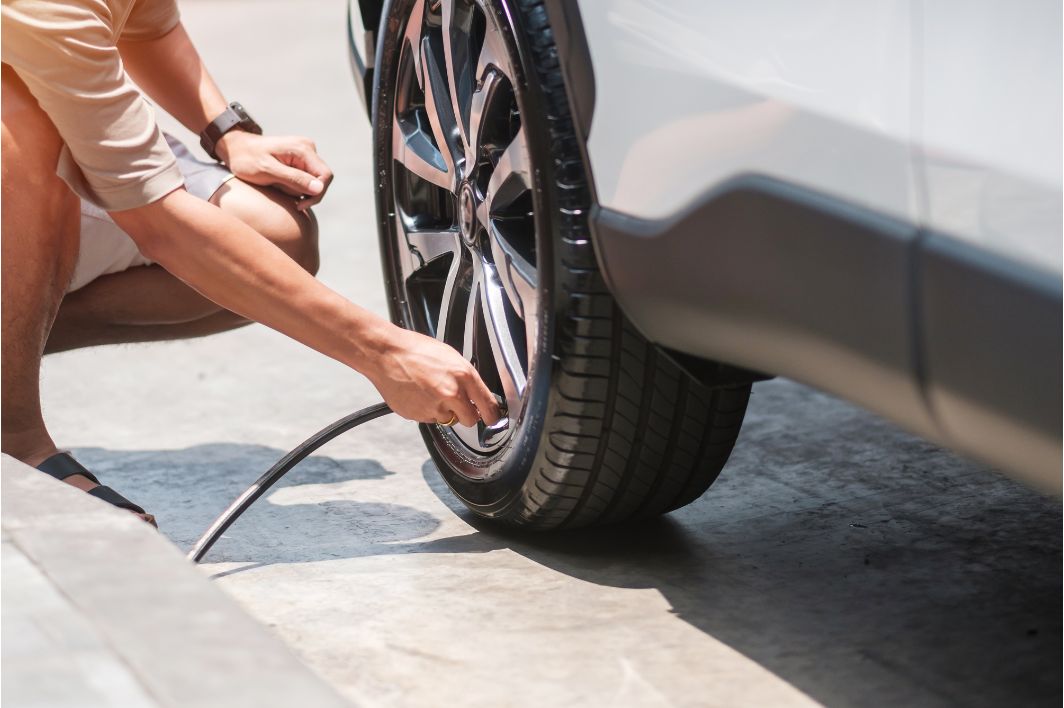
Inflating your tyres is a quick and straightforward job you can do yourself at any Moeve Service Station. Just follow these steps:
Step 1: Find the manufacturer's recommended pressure:
Forget generic figures or rule-of-thumb guesses. The correct pressure is the one specified by your vehicle manufacturer. You will find this information on a sticker usually located on the driver's door frame, on the fuel filler cap, or in the owner's manual. You will notice that different pressures are given for the front and rear tyres, and sometimes different values for when the car is fully loaded.
Step 2: Always measure the pressure with cold tyres:
This is a crucial point. Pressure should be measured when the tyres are "cold", meaning you have driven less than 3 to 4 kilometres. As you drive, friction heats up the air inside, which increases the pressure and can give you a false reading. If you have no choice but to measure them when warm, add around 0.3 bar to the manufacturer's recommended pressure.
Step 3: Remove the valve cap:
Unscrew the small plastic cap that protects the valve on each tyre. Keep it somewhere safe so you do not lose it while you work.
Step 4: Connect the gauge and check the pressure:
Bring the air compressor hose up to the valve. Press the nozzle firmly to prevent air from escaping and read the pressure shown on the gauge. Compare that figure with the one recommended by the manufacturer.
Step 5: Inflate to the correct pressure and replace the cap:
If the pressure is below the recommended level, press the compressor lever to add air. Do it in short bursts, checking the pressure every few seconds to avoid over-inflating. If you have added too much air, most nozzles have a small pin or button that, when pressed, releases the excess. Once you have reached the exact pressure, remove the nozzle and screw the valve cap back on. Repeat the process for all four tyres.
Where can you inflate your car tyres?
There are several types of places where you can inflate your car tyres.
Service stations
At virtually every service station, including Moeve's, you will find air compressors to adjust your tyre pressure in line with the manufacturer's recommendations.
You will usually find the inflator in a designated area of the forecourt or next to the car wash. Simply remove the valve cap, select the indicated pressure and connect the compressor nozzle until the gauge shows the correct level.
Shopping centres
Many shopping centres have car parks equipped with basic vehicle maintenance areas, where air inflators or associated service stations can sometimes be found.
Mechanical workshops
Most trusted garages will have no problem checking and adjusting your tyre pressure, often at no charge, especially if you are a regular customer.
Inflating at home
Another option is to buy a portable air compressor. They are affordable, plug into your car's 12V socket and allow you to check the pressure comfortably in your own garage, making sure your tyres are always cold. Battery-powered compressors are also available, meaning no power socket is required.

Common mistakes when inflating your car tyres
Avoid these frequent errors to ensure a perfect inflation every time:
Not checking the pressure before inflating:
Many drivers simply "add a bit of air" without knowing the starting pressure. This is a mistake, as you have no real reference point and the final pressure is very likely to end up off the mark.
Over-inflating the tyres:
Too little pressure is just as problematic as too much. An over-inflated tyre reduces the contact surface with the road, which diminishes grip. It also makes the suspension stiffer and increases the risk of a blowout when going over a pothole.
Inflating warm tyres:
As already mentioned, heat distorts the reading. Plan your stop so you check the pressure at the start of your journey, not halfway through or at the end.
Ignoring the recommended pressure:
Do not rely on the maximum pressure printed on the side of the tyre. That figure indicates the maximum the rubber can withstand, not the pressure at which it should operate in your vehicle. Always follow the car manufacturer's recommendation.
Frequently asked questions about how to inflate car tyres
The theory is clear, but it is perfectly normal for practical questions to arise at the last minute. To help you approach the gauge with complete confidence, we have put together those questions we have all asked ourselves at some point. Here are the answers, straight to the point.
Is it safe to inflate tyres at a service station?
Yes, it is completely safe. Service station gauges are designed to be easy to use and are certified by a specialist company. Simply follow the steps outlined above.
What happens if I drive with under-inflated tyres?
We have already touched on this. Driving with low tyre pressure is dangerous. It reduces grip, increases braking distance, causes premature tyre wear and raises fuel consumption. It also increases the risk of a blowout.
Can I inflate my tyres with a portable compressor?
Absolutely. It is an excellent alternative. It lets you adjust the pressure at home with the tyres completely cold, ensuring a much more accurate reading.
As you can see, keeping your tyres at the correct pressure is one of the simplest, most affordable and most important maintenance tasks you can carry out. Spending just five minutes on it each month can save you money, extend the life of your tyres and, most importantly, keep you and your passengers safe on the road.