Index
What pressure should your tyres be at?
This is the question everyone asks, and the answer is simpler than it sounds: the correct pressure is the one your vehicle's manufacturer recommends. There's no universal figure, since every car — based on its weight, size and design — has its own specific requirements. Ignoring that recommendation and relying on generic values is a mistake that can prove costly.
Where to find the recommended pressure
The manufacturer makes it easy. You can find the recommended tyre pressure — both for normal load and full load conditions — in several places:
- On the sticker inside the driver's door frame: This is the most common spot. Open the door and you'll find a label with a pressure chart.
- In the vehicle owner's manual: Your car's handbook is a valuable source of information and will always include this data.
- On the inside of the fuel cap: Some models also place the sticker here.
Factors that affect tyre pressure
Pressure isn't static — it changes depending on a number of factors worth keeping in mind:
- Vehicle load: There's a difference between driving alone and travelling with the whole family and a full boot. That's why manufacturers specify different pressures for partial and full loads. If you're heading out on a long trip, it's worth knowing how to distribute your luggage efficiently to save fuel and adjusting the pressure to match the extra weight.
- Temperature: Cold and heat both affect the air pressure inside the tyre. We'll explore this in more detail later, but it's something to keep an eye on.
- Tyre type: Although the recommended pressure is determined by the vehicle, understanding the different tyre types and their characteristics will help you get a better sense of how they behave.

What happens when tyre pressure isn't right
Neglecting tyre pressure might seem like a minor oversight, but the consequences can affect three critical areas: fuel consumption, tyre lifespan and, most importantly, your safety.
Higher fuel consumption
An underinflated tyre increases its contact surface with the road, which in turn increases rolling resistance and forces the engine to work harder. The result? Fuel consumption can rise by as much as 10%.Efficient driving starts with something as straightforward as making sure your tyres are properly inflated.
Uneven tyre wear
Incorrect pressure causes tyres to wear unevenly, significantly shortening their lifespan.
- Low pressure: The tyre wears more along the outer edges.
- High pressure: Wear is concentrated in the centre of the tread.
Uneven wear will mean you need to replace your tyres sooner than expected. That's why, alongside pressure, it's worth knowing how long tyres typically last and when to change them so you're always driving safely.
Uneven wear can also cause noise and vibrations — a problem sometimes described as "cupping" or "saw-tooth" wear. This occurs when the contact surface becomes irregular, producing an annoying hum or vibration that gets worse the faster you go.
Safety risks
This is where things get serious. Incorrect tyre pressure directly compromises your safety:
- Reduced grip: An underinflated tyre deforms and loses traction, especially in corners or on wet roads.
- Longer braking distance: Your car will need more distance to stop — which can be critical in an emergency.
- Greater risk of aquaplaning: With low pressure, the tyre struggles to channel water away effectively, increasing the risk of aquaplaning.
- Risk of blowout: Severely underinflated tyres can overheat, which may lead to a blowout — particularly at high speeds.
How to check tyre pressure correctly
Checking your tyre pressure is a simple task you can do yourself in just a few minutes. Doing it regularly — at least once a month and always before a long journey — is the best way to stay ahead of potential problems.
What you'll need
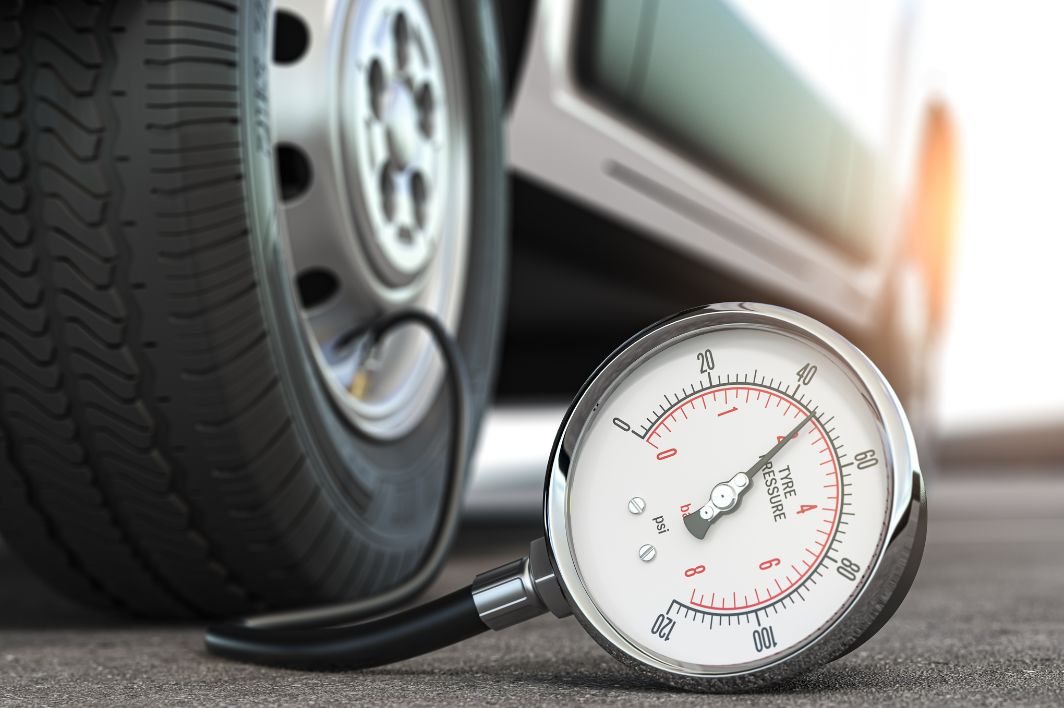
- Tyre pressure gauge: This is your measuring tool. You can find reliable gauges at our service stations.
- Air compressor: Essential for inflating the tyres. Also available at all Moeve Service Stations.

Step-by-step guide to checking tyre pressure
- Step 1 – Check when cold: The most accurate readings are taken when the tyres are "cold" — meaning the car has been driven less than 3 km. Heat from driving expands the air inside and skews the reading.
- Step 2 – Find the valve: Remove the dust cap from the tyre valve.
- Step 3 – Attach the gauge: Press the gauge nozzle firmly onto the valve until the air stops hissing.
- Step 4 – Read the pressure: The gauge will display the current pressure in bar or PSI.
- Step 5 – Compare and adjust: Check the reading against the manufacturer's recommendation. If it's low, use the compressor to add air. If it's high, press the small pin in the centre of the valve to let some out.
- Step 6 – Re-check: Repeat the process until you hit the exact pressure.
- Step 7 – Replace the cap: Put the dust cap back on to protect the valve from dirt.
- Step 8 – Check all wheels: Don't forget the other three tyres and, crucially, the spare tyre.
FAQs about tyre pressure
Below, we answer some of the most common questions regarding this topic.
Is the pressure different for front and rear tyres?
Yes, in many cars, the recommended pressure differs between the front and rear axles. This is because weight isn't distributed evenly (the engine is usually at the front). Always consult the manufacturer's sticker for your vehicle's specific values.
How does outside temperature affect tyre pressure?
Air expands with heat and contracts with cold. Therefore, in summer, pressure tends to rise, while in winter, it drops. It’s a good idea to check your pressure more often during seasonal changes. For this reason, using winter tyres in summer is not recommended, as they are designed to perform at much lower temperatures.
What happens if I drive on underinflated tyres for a long time?
Driving continuously with low pressure accelerates wear, increases fuel costs, and most dangerously, severely compromises safety. It heightens the risk of a blowout and reduces the car’s ability to respond to unexpected situations.
Is it better to measure pressure when cold or hot?
As mentioned: always when cold. Manufacturer recommendations are based on tyres at ambient temperature. If you measure when they are hot (after a long drive), the reading will be higher than the actual baseline. If you have no choice but to check them while hot, add about 0.3 bar to the recommended figure to compensate for the temperature effect.
As you've seen, knowing your tyre pressure and how to check it correctly is a simple habit with a massive impact. It’s a small investment of time that leads to significant savings in fuel and repairs, and above all, ensures greater safety for you and your passengers.