Index
What is a toll motorway?
Let's start by defining exactly what characterises a toll motorway and why this type of road infrastructure was designed.
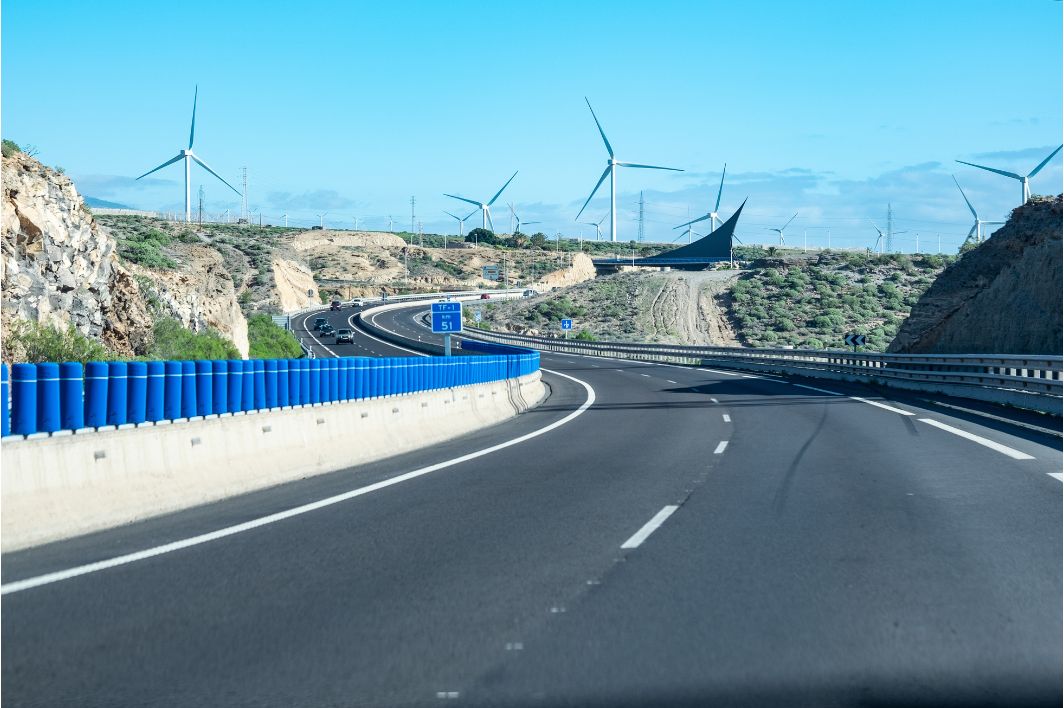
A toll motorway is a road built for high-speed motor traffic. It features multiple lanes in each direction, completely separated by a central reservation, and limited access points via specific junctions.
Toll motorways are identified by the prefix "AP" (Autopista de Peaje). Their key features include at least two lanes per direction, full separation via physical barriers, controlled access points that minimise disruption, a toll system in many cases, and full service areas every 40 to 60 kilometres.
What is a motorway?
Motorways emerged as a toll-free alternative to toll motorways, opening up high-capacity roads to drivers right across Spain.
A motorway is also a high-capacity road with characteristics similar to a toll motorway, but generally without tolls. They are identified by the letter "A" followed by a number. They feature separate carriageways for each direction, typically two lanes per direction (which can be extended in metropolitan areas), more frequent access points than toll motorways, and are designed to connect mid-sized towns and improve access to rural areas.

Key differences between a toll motorway and a motorway
Beyond the question of tolls, there are structural and functional differences between the two types of road that directly affect your driving experience.
Tolls
The financial aspect is probably the most obvious distinction between the two.
Toll motorways have traditionally required toll payments, while motorways are free to use. That said, some toll motorways operate without charges, and certain toll roads have become free once their concession period has come to an end.
The cost varies depending on distance, vehicle type and the operating company, and was introduced to fund construction and maintenance without relying solely on public money.
Access points and technical features
The design of access points makes a significant difference in terms of safety and traffic flow.
Toll motorways have more widely spaced access points (every 10 to 15 km), with longer acceleration and deceleration lanes that allow for safer merging. Their junctions tend to be more complex. Motorways have more frequent access points (every 5 to 7 km) to connect more towns, though these may be less developed.
Infraestructure
The quality and frequency of available services varies considerably between the two types of road.
Toll motorways have more complete infrastructure: frequent service areas with a full range of facilities, wider hard shoulders and regular maintenance. Motorways also have service areas, though more spread out. Many have significantly improved their infrastructure in recent years, however.
Speed limits and restrictions
Traffic regulations are broadly similar, though there are some nuances worth being aware of.
On both types of road, the maximum speed is 120 km/h for cars and motorcycles, with possible restrictions on specific stretches. The rules are identical: pedestrians, cyclists, mopeds and vehicles unable to reach 60 km/h are all prohibited from using them.
Advantages and disadvantages of toll motorways and motorways
Each type of road has its own benefits and drawbacks, which you should weigh up based on your specific needs.
Toll motorways
Toll motorways offer advantages that can justify their cost in certain situations.
- Advantages: Better traffic flow, comprehensive service infrastructure, higher maintenance standards, lower traffic density and wider lanes.
- Disadvantages: Significant toll costs on longer journeys, fewer access points and limited availability on some routes.
Motorways
Motorways have become the backbone of Spain's road network.
- Advantages: Free to use, more frequent access points, broad territorial coverage and direct cost savings.
- Disadvantages: Higher traffic density during holiday periods, more widely spaced services and potentially less frequent maintenance.
Practical examples of toll motorways and motorways in Spain
There's no better way to understand the difference between a toll motorway and a motorway than through real-life examples.
- Notable toll motorways: AP-7 (Mediterranean), AP-6 (Madrid to Galicia) and AP-9 (Galician Atlantic).
- Key motorways: A-1 (Madrid to Burgos), A-2 (Madrid to Barcelona), A-3 (Madrid to Valencia) and A-4 (Madrid to the South).
In many cases, toll motorways and motorways run parallel to each other, giving drivers a choice.
How to choose between a toll motorway and a motorway for your journey?
The decision should be based on your priorities and the specific characteristics of your trip.
Budget
For many drivers, cost is the deciding factor when planning a route.
If saving money is your priority, motorways are the better option. That said, it's worth keeping in mind that extra travel time has its own value, as does the potentially higher fuel consumption on longer or more congested routes.
Type of journey
The nature of your trip will determine which option suits you best.
- Urgent journeys: A toll motorway offers greater speed and smoother traffic flow.
- Relaxed journeys: A motorway allows for more stops and connections to a greater number of towns.
- Professional journeys: Electronic toll devices speed up the process and offer discounts, such as the Moeve pro VIA-T.

Frequently asked questions about toll motorways and motorways
Here we answer the most common questions about these two fundamental types of road infrastructure.
Why do toll motorways have charges but motorways don't?
The funding model explains this key difference between the two types of road.
The toll system was put in place so that concession companies could finance construction using private capital, recouping their investment over a period of 25 to 50 years.
Motorways are funded through public money from the national budget, which is what makes them free to use.
Can both types of road be used without restrictions?
It's important to know which vehicles are permitted on these high-capacity roads.
Yes, they can be used by any motor vehicle capable of reaching at least 60 km/h. Pedestrians, cyclists, mopeds and animal-drawn vehicles are excluded. On toll motorways, you will need to pay the applicable fee.
Is it safer to drive on a toll motorway or a motorway?
Safety is a legitimate concern, and it deserves a clear, data-based answer.
Both are significantly safer than conventional roads. Toll motorways have slightly lower accident rates thanks to their more restricted access, but safety ultimately comes down to driver behaviour: respecting speed limits, maintaining a safe following distance and adapting your driving to weather conditions.
How can I choose or avoid tolls using a sat-nav?
Most navigation apps, such as Google Maps or Waze, let you customise your route to include or avoid tolls. Before setting off, look for the "Avoid tolls" option in your route settings. Once activated, the app will suggest a toll-free alternative. This feature is particularly useful for keeping track of your travel costs and finding the option that best suits your budget and schedule.
Understanding the difference between a toll motorway and a motorway helps you plan your journeys more effectively, taking into account factors such as budget, time and the nature of your trip. The right choice will depend on your specific priorities, but what matters most is always driving safely and efficiently, respecting traffic regulations and keeping your vehicle in good condition so you can enjoy every journey with complete peace of mind.