Index
Basic rules for navigating a roundabout correctly
Getting comfortable with roundabouts is simply a matter of internalising a few core rules that will serve you well at any junction of this kind.
Who has priority at a roundabout?
The golden rule is straightforward: priority always belongs to vehicles already circulating inside the roundabout. When entering, you will see a "Give Way" sign, which requires you to slow down and stop if necessary.
How to signal your manoeuvres correctly
Indicators are used solely to signal a lane change within the roundabout or to show that you are about to take the next exit. It is neither necessary nor correct to use the left indicator to show that you intend to continue around the roundabout.
Choosing the right lane
As a general rule, use the outer lane, as it allows you to take any exit. Inner lanes are for overtaking or for when your exit is not one of the first ones coming up. When leaving the roundabout, you must always do so from the outer lane, moving into it in good time and with the appropriate signals.
Watch out for other vehicles inside the roundabout
Practise defensive driving. Never assume that everyone knows the rules. Observe the behaviour of other vehicles, anticipate their movements and always maintain a safe following distance. Good vehicle maintenance, with brakes and tyres in perfect condition, gives you that extra margin of safety.

Common mistakes that cause roundabout accidents
Knowing the most frequent errors is the best way to avoid them yourself and to anticipate what other drivers might do.
Changing lanes without signalling
This is one of the leading causes of side-on collisions. If you fail to indicate your intention to change lanes, for example to move into the outer lane before your exit, the driver alongside you will have no warning, creating a high-risk situation.
Entering the roundabout without giving way
This is the most common mistake. Impatience or a misjudgement of another vehicle's speed leads drivers to pull out prematurely, causing a collision. Remember: the "Give Way" sign is not a suggestion; it is a legal obligation.
Travelling through the roundabout at excessive speed
High speed reduces your reaction time and that of everyone around you. It also increases the risk of losing control of your vehicle, particularly when faced with unexpected situations or when the road surface is wet. Keep wet-weather driving precautions in mind and always adjust your speed accordingly.
Failing to check blind spots
When moving from the inner lane to the outer lane, it is vital to check your blind spots. A car or motorbike may be travelling in the right-hand lane, and if you fail to spot it, a collision is almost inevitable.
Leaving the roundabout at the last moment
This is the most dangerous manoeuvre: attempting to exit the roundabout directly from an inner lane, cutting across vehicles correctly positioned in the outer lane. This is illegal and a direct cause of serious accidents.
Types of roundabout and how to handle each one safely
Not all roundabouts are the same. Understanding the different types will make you a more confident driver.
Standard roundabout
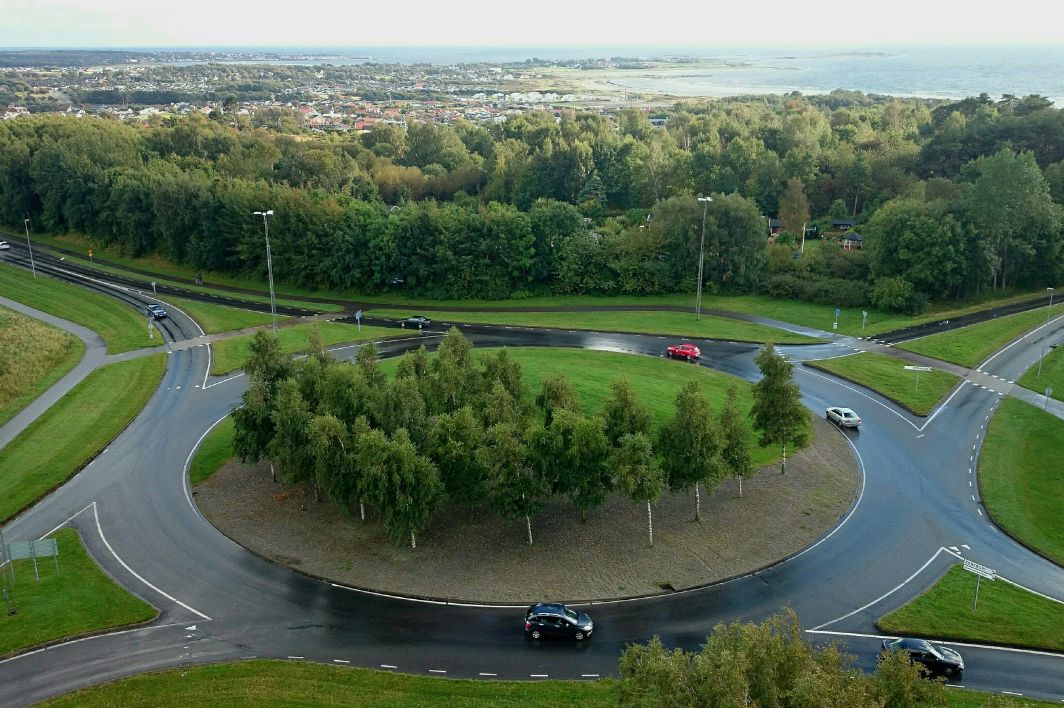
The most common type, with a single lane. The rules here are simple: give way on entry and signal before your exit.
Split roundabout or roundabout with traffic lights
In these cases, priority is determined by the traffic lights. If the light is green, you have priority to enter. If the lights are off or showing an amber flash, revert to the standard give way rule.
Roundabouts with reverse priority
These are very rare, but they do exist. In these cases, a "Give Way" sign inside the roundabout indicates that you must yield to vehicles entering from outside. They will always be clearly signposted.

Fines related to roundabout incidents
Breaking the rules at a roundabout is not only dangerous; it also carries financial penalties. Failing to give way, making improper lane changes or exiting incorrectly can result in fines that generally amount to 200 euros.
Frequently asked questions about roundabout accidents
Even with the rules clearly understood, roundabouts can throw up specific situations that leave drivers unsure. Here are answers to the most common questions, so you are left with no lingering doubts.
What happens if two cars collide while trying to exit a roundabout from different lanes?
Generally, liability falls on the vehicle travelling in the inner lane, as it is the one making a lane change to exit and is therefore required to give way to the vehicle already in the outer lane.
Do I have to give way to a vehicle that did not signal?
Yes. Priority belongs to the vehicle already inside the roundabout, regardless of whether it signalled. Your obligation is to give way.
Which lane should I use if I want to do a full 360-degree turn?
The safest and most compliant option is to stay in the outer lane throughout. This allows you to complete the full loop without needing to change lanes at any point.
Are there different rules depending on the city or roundabout?
The fundamental rules governing roundabouts, including right of way and lane use, are set at national level and regulated by the DGT. Local councils may introduce supplementary measures such as speed limits, but cannot alter the core rules of circulation.
How does right of way apply to cyclists at a roundabout?
A group of cyclists is treated as a single unit. Once the first cyclist in the group has entered the roundabout, the entire group has priority. You must wait for the last cyclist to pass before pulling out.
Navigating roundabouts does not have to be a headache. With these rules and a defensive driving mindset, you will handle any roundabout with confidence. At Moeve, we want every journey to be a positive, safe and efficient experience.
Find out more
For a more detailed look at the regulations governing roundabout circulation, you can consult the General Traffic Regulations, approved by Royal Decree 1428/2003, available on the Official State Gazette: https://www.boe.es/buscar/act.php?id=BOE-A-2003-23514.