Index
What do the regulations say about phone mounts on the dashboard?
Spanish road traffic law, as set out in the Reglamento General de Circulación, does not explicitly prohibit placing a phone mount on the dashboard or windscreen. However, article 19.1 lays down a fundamental rule: drivers are required at all times to maintain freedom of movement, an adequate field of vision, and full attention to the road.
What does this mean in practice? That you can use a mount, but it must never obstruct your view of the road. Any object that reduces your field of vision, however small, is considered an infringement. So the legality of using a phone mount on the dashboard doesn't depend on the act itself, but on how and where you position it.
What are the risks of mounting your phone on the dashboard?
Beyond the potential fine, positioning your phone incorrectly in the car carries real dangers that are worth understanding. It's not just about following the rules; it's about understanding why they exist.
Blocking the driver's line of sight
A poorly positioned mount, especially suction-cup types placed in the centre of the windscreen, can create a significant blind spot. That small obstruction could hide a pedestrian, a cyclist or even another vehicle at a junction or roundabout. Any element that interferes with your direct view of the road dramatically increases the risk of failing to react in time to an unexpected hazard.
Distraction when using the device
This is, without doubt, the greatest risk of all. Handling your phone while driving, even just to skip a song or adjust the GPS route, involves three types of distraction:
- Visual: you take your eyes off the road.
- Manual: you take one or both hands off the wheel.
- Cognitive: your attention shifts to the phone rather than staying on the road.
According to the DGT (Spain's Directorate General of Traffic), taking your eyes off the road for just 5 seconds at 100 km/h is the equivalent of travelling more than 140 metres blind. As we explored when looking at the most dangerous moments of distraction behind the wheel, technology is one of the leading risk factors.
Hazards in the event of an accident
A phone or mount that isn't securely fastened can become a dangerous projectile in the event of sudden braking or a collision. What's more, if the device is positioned in the airbag deployment zone, it could be launched towards the vehicle's occupants with tremendous force, causing serious injury.

How to mount your phone on the dashboard safely
Fortunately, technology offers us safe ways to use our phones for navigation. The key is to choose an approved mount and, above all, to position it somewhere that doesn't compromise your vision in any way.
Types of permitted phone mounts and how to use them
There's a wide range of mounts on the market. What matters most is that they are good quality and correctly installed.
Suction-cup mounts for dashboards
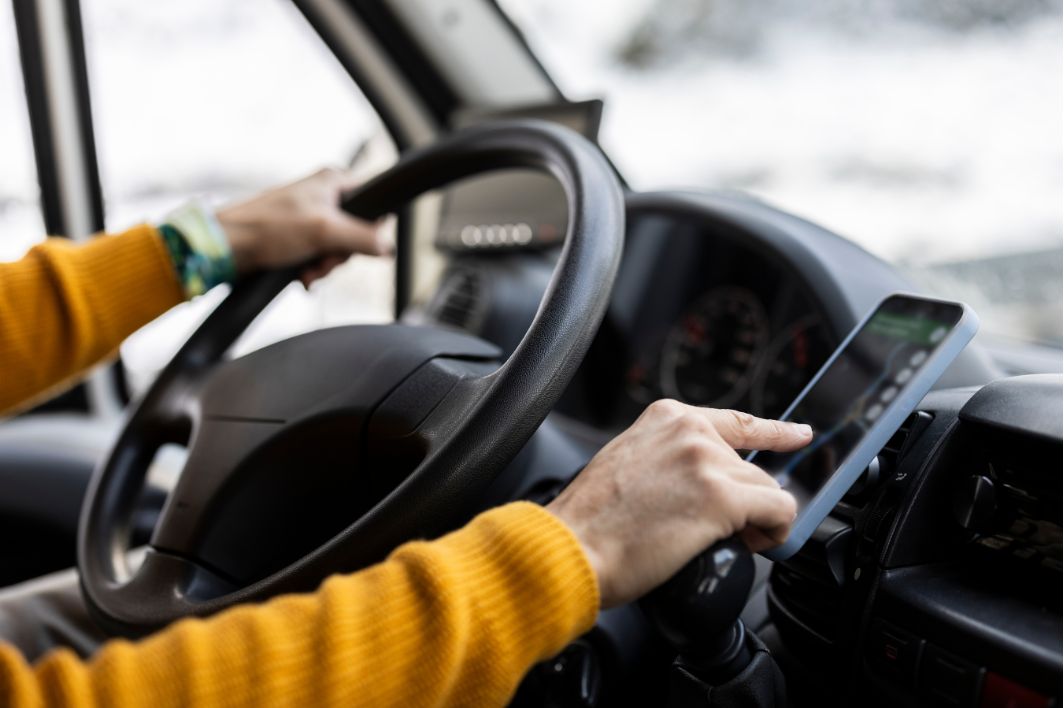
These are hugely popular, but correct placement is essential. They should be positioned in the lower left corner of the windscreen, or on the dashboard itself in a low position where they don't block the view of the road. They should never be placed in the centre of the glass.
Air vent mounts
This is one of the safest options, as it doesn't interfere with the driver's field of vision at all. The mount clips onto the slats of one of the air vents. Its main drawback is that it can partially block the airflow.
Magnetic mounts
These work via a magnet that attaches to the car and a metal plate fitted to the phone case. They're very convenient, but make sure the magnet is strong enough to keep the phone in place on bumpy roads.
Adhesive mounts
These stick directly to the dashboard and provide a very secure hold. However, the placement is more permanent and they may leave residue or damage the surface if you decide to remove them later.

Fines for incorrectly mounting your phone on the dashboard
The regulations on mobile phone use while driving are strict. If a traffic officer considers that the mount or phone is obstructing your vision, the fine can be €100.
The most serious penalty, however, is for handling your phone while driving. This carries a fine of €200 and the loss of 6 points from your driving licence. It makes no difference whether you're holding the phone in your hand or it's in a mount; simply touching the screen to change your route or reply to a message is enough to warrant a penalty.
Permitted uses of your phone in the car
There are, of course, legal and safe ways to use your phone. The main one is as a GPS, provided it is mounted in an approved holder, in a position that doesn't reduce visibility and, crucially, with the route set before you set off. You can also use it as a music player, controlled via the steering wheel controls or by voice command. Phone calls are only permitted using an approved hands-free system.
Tips for avoiding distractions when using your phone in the car
When it comes to minimising risk, prevention is always the best strategy. Follow these tips to use your phone safely and responsibly behind the wheel:
- Plan before you drive: Set up your GPS and playlist before you start the engine.
- Use voice commands: Take advantage of voice assistants like "OK Google" or "Hey Siri" to perform actions without touching the screen.
- Enable "Do Not Disturb" mode: Many phones have a driving mode that silences notifications automatically.
- Let your passenger help: If you're travelling with someone, let them handle the phone.
- If it's urgent, pull over: Safety comes first. If you absolutely need to do something on your phone, find a safe place to stop, such as a rest area or a Moeve Service Station, and use your phone with the engine off.
In short, technology can be a great ally on the road, but it should always serve safety. Using your phone as a GPS is a useful and perfectly legal practice, as long as it's done responsibly. With the right mount in the right position, you can navigate without risk and without worrying about a fine.
Find out more
For a more detailed look at the regulations on mobile phone use while driving, you can consult the Reglamento General de Circulación on Spain's Official State Gazette: https://www.boe.es/buscar/doc.php?id=BOE-A-2025-12199.