Index
Types of charging for electric cars
There are three main types of electric car charging, distinguished by their power output and speed. It's worth noting that not all chargers are compatible with all electric vehicles.
- Slow charging: Ideal for overnight charging at home. It uses a standard domestic socket or a dedicated charging point, with a power output typically below 7.4 kW. A full charge can take between 6 and 12 hours.
- Semi-fast charging: Offers an intermediate charging speed and can be found in public car parks, shopping centres and some service stations. Power output ranges from 7.4 kW to 22 kW, with charging times of between 1 and 4 hours. Some semi-fast chargers reach up to 43 kW, significantly cutting charging times.
- Fast charging: Perfect for long journeys. Available at service stations and dedicated charging hubs, it delivers significantly faster charging speeds, with power outputs ranging from 50 kW to 150 kW. It can charge a battery from 20% to 80% in just 20 to 30 minutes.
- Ultra-fast charging: The quickest option available. With power outputs above 150 kW — often 350 kW or more — it can charge a battery from 20% to 80% in as little as 15 to 20 minutes. We are driving the development of the largest electric mobility ecosystem on the Iberian Peninsula, with ultra-fast chargers at our Service Stations.
While there are various nuances to electric vehicle charging, the International Electrotechnical Commission has established four main charging modes to standardise the process:
- Mode 1: Slow AC charging using a standard domestic socket, with no modifications required.
- Mode 2: Similar to Mode 1, but with an added protection device built into the charging cable for greater safety.
- Mode 3: Covers normal, semi-fast and fast charging, and requires a dedicated charging point. This is the most common mode, allowing for efficient charging management.
- Mode 4: Covers fast and ultra-fast DC charging. It requires a specialised charging point and delivers significantly higher charging speeds.
Where to charge an electric car away from home
If you need to charge your electric car while out and about, there are plenty of options to choose from:
Charging hubs
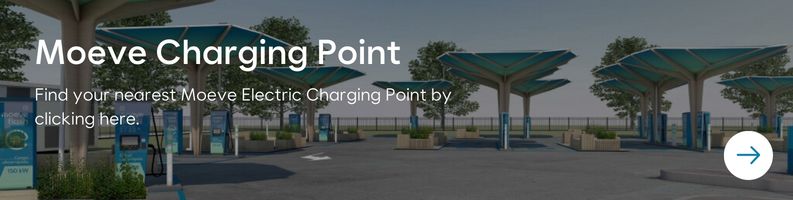
Dedicated charging hubs offer fast, efficient charging through multiple rapid or ultra-fast charging points — ideal for long trips or whenever you need a quick top-up in the city.
Shopping centres, offices and car parks with charging points
Many shopping centres, office buildings and public car parks now have electric vehicle charging points, making it easy to charge your car while you shop or work. These stations typically offer slow charging, often free of charge.
Charging on roads and at service areas
An increasing number of motorway service areas now feature fast charging points, making long-distance electric driving more straightforward than ever.
Planning long trips around fast charging stations and hubs
For longer journeys, it's a good idea to plan your route with charging locations in mind. Use navigation apps designed for electric vehicles to identify the available stations along your way.
How to charge an electric car away from home
At Moeve, we'll guide you through charging your car at one of our Service Stations in just a few simple steps. There are two ways to charge:
Using the Moeve App
- Download the Moeve App and sign up to Club Moeve gow to enjoy the exclusive benefits and promotions designed for you.
- Find your desired charging point on the map. Tap "Charge vehicle" and select your connector.
- Choose your preferred payment method. If you have accumulated credit or a promotional voucher you'd like to redeem, select it at this stage.
- Plug in your vehicle and tap "Start charging".

Using your bank card
If you'd prefer to pay by card, follow these steps:
- Press the Credit Card button and tap your card on the card reader.
- Select your connector.
- When the connector light turns blue, plug the cable into your vehicle — charging will begin automatically. .
- To unlock the screen, press the active session button twice and tap your card on the card reader.
- To end the charging session, unlock the screen, press Stop and tap your card on the card reader. Then unplug the charger and replace the cable.
- Press the Receipt button and tap your card on the card reader to view your charging summary
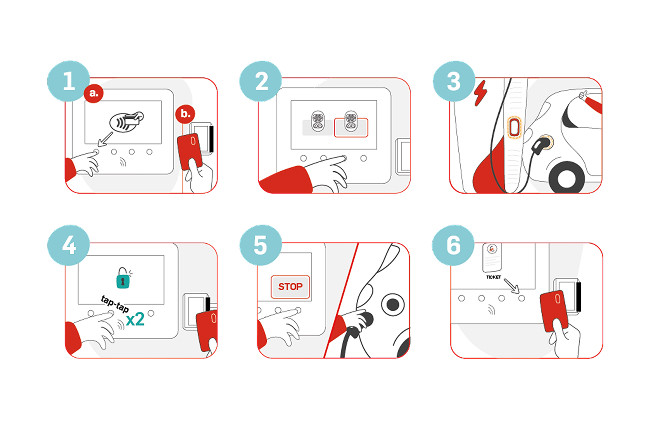
The process is exactly the same if you prefer to pay via contactless on your smartphone (RFID).
How to charge an electric car at home
Charging at home is the most convenient and cost-effective option. Domestic chargers (Level 2 – 230V) typically cost between €400 and €1,200, plus installation (between €500 and €1,500). Imagine waking up every morning with a fully charged battery, ready for whatever the day brings. Here's how to make it happen:
Requirements for installing a home charging point
To install a charging point at home, you'll need a private garage space and the services of a certified installer. This professional will assess your needs and carry out the installation safely, in full compliance with current regulations.
Types of home chargers
There are different home charging options available, from semi-fast chargers — which offer quicker, safer charging — to standard plug adapters. A qualified installer will help you choose the best solution for your vehicle and your home's electrical setup.
The benefits of charging at home
- Convenience: Charge your car overnight or while you go about your day at home.
- Savings: Domestic electricity is generally cheaper than charging at public stations.
- Safety: Home charging points offer a higher level of safety compared to standard sockets.
How long does it take to charge an electric car at home?
Charging time depends on your battery capacity and the power of your charger. With a semi-fast charger, a full charge typically takes between 1 and 4 hours; with a standard socket, it can stretch to 12 hours or more.
How much does it cost to charge an electric car?
The cost of charging an electric car varies depending on where you charge and the tariff you're on (in the case of home charging). It's worth thinking about your priorities and needs before making any decisions.
Are there any discounts or special plans for electric charging?
Some energy providers offer special tariffs for electric vehicle charging. Check with your supplier to find out what options are available to you.
From our side, making the switch to electric mobility comes with real benefits — and we want to make that transition as easy as possible through the charging points at our Service Stations. As part of our commitment to decarbonising transport, you'll also find up-to-date information on grants and subsidies related to electric mobility, including the Moves III Plan.
Common charging problems and how to solve them
It's worth getting to know the most common issues you might encounter when charging an electric vehicle — and how to deal with them:
Connector incompatibility
- Problem: The charger connector doesn't fit your vehicle's socket.
- Solution: Make sure the charging station offers the right connector for your car model. Check your vehicle's manual or use an app that shows charger compatibility.
Charging station malfunction
- Problem: The charging station isn't working or the session cuts out.
- Solution: Try restarting the station or contact the provider's customer support. If the issue continues, look for an alternative nearby.
Payment issues
- Problem: The charging session won't start due to a payment problem.
- Solution: Check that your card is enabled for contactless payments, or that you have sufficient credit in the app. Try an alternative payment method if possible.
Slow charging
- Problem: Charging is taking longer than expected.
- Solution: Make sure you're using the correct charging mode for your vehicle and the station. Ambient temperature can also affect charging speed. If the issue persists, contact technical support.
The app isn't working
- Problem: The charging management app isn't functioning properly.
- Solution: Close and reopen the app. If the problem continues, try uninstalling and reinstalling it, or get in touch with customer support.
Find out more
For a more detailed look at the four charging modes standardised by the International Electrotechnical Commission, you can consult the following technical document:
https://cdn.standards.iteh.ai/samples/23206/8da8f4453f3b41f584ae2abad7295938/IEC-61851-24-2023.pdf