Index
What is a solar charging station?
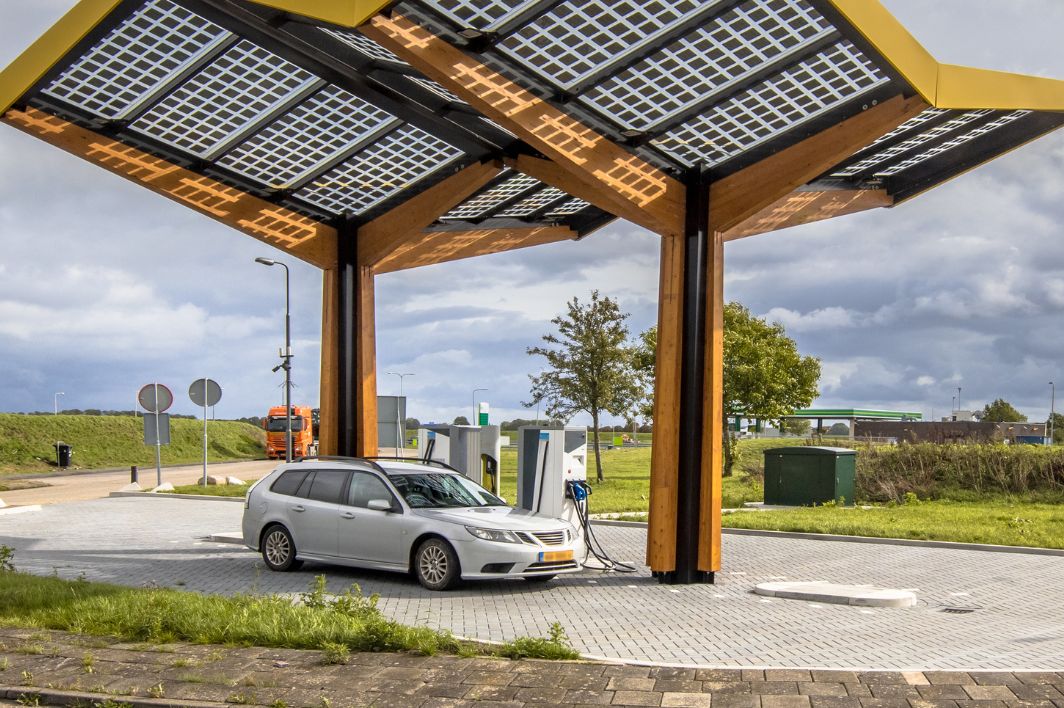
A solar charging station is, at its core, an electric vehicle charging station that draws its energy directly from the sun. Through photovoltaic solar panels, it captures sunlight and converts it into the electricity needed to charge the batteries of electric cars, motorbikes or scooters.
The key difference from a conventional charging point lies in its energy source. While a standard charger connects to the general electricity grid, a solar charging station generates its own clean, renewable energy on-site. This makes it a self-consumption solution — reducing grid dependency and minimising the carbon footprint associated with charging.

How does a solar charging station work?
A solar charging station operates through the integration of three key components that work in harmony to deliver an efficient, lower-impact charging experience.
Photovoltaic solar panels
These are the heart of the solar charging station. Made up of silicon cells, the panels capture sunlight and, through the photovoltaic effect, convert it into direct current (DC) electricity. The amount of energy generated depends on factors such as solar intensity, panel orientation and the absence of shading.
Energy storage system
Since the sun doesn't shine around the clock, solar charging stations typically incorporate an energy storage system — usually lithium-ion batteries.
These batteries store the surplus energy produced during daylight hours, making it available for charging at night or on overcast days, and ensuring a continuous, uninterrupted service.
Electric vehicle charging points
The energy generated and stored is channelled to one or more charging points. These can cover a range of charger types — from semi-fast to fast or ultra-fast charging (such as Moeve's) — giving users the flexibility to choose the option that best suits their needs and available time.
An inverter is responsible for converting the direct current (DC) from the batteries into the alternating current (AC) used by the majority of electric vehicles during charging
Benefits of solar charging stations
Investing in solar charging stations brings a wide range of advantages — for users and the environment alike:
- 100% renewable energy: They harness a clean, inexhaustible and free energy source, bringing CO₂ emissions associated with charging down to zero.
- Cost savings: By generating their own electricity, operating costs are reduced and a more competitive price per kWh is passed on to the end user.
- Grid independence: They reduce reliance on the conventional electricity grid, making them ideal for rural areas or regions with less developed electrical infrastructure.
- A boost for self-consumption: They promote a decentralised, responsible energy model, where energy is produced and consumed in the same place.
Solar charging stations for businesses and public authorities
Installing solar charging stations isn't just an option for public spaces. More and more businesses and public institutions are embracing this solution for their own fleets and employees. Setting up solar-powered charging points in company car parks can significantly cut operating costs and carbon emissions.
What's more, offering this service to employees becomes a powerful incentive and a clear reflection of a company's commitment to environmental responsibility — aligning with the expectations of an increasingly sustainability-conscious society.

Challenges and the future of solar charging stations
Despite their clear advantages, the wider rollout of solar charging stations still faces some hurdles:
- Upfront installation costs: The initial investment in solar panels, batteries and charging points can be significant, though it is recoverable in the medium term thanks to energy savings. Programmes such as the Plan MOVES for businesses offer grants that can help offset this cost.
- Space requirements and strategic positioning: They require a considerable surface area for solar panel installation, as well as a location with good sun exposure.
- Technological evolution and emerging trends: The future points towards higher-capacity, longer-lasting batteries, smarter energy management systems, and the integration of solar charging stations into distributed energy networks (smart grids) — even enabling surplus energy to be fed back into the grid.
Examples of solar charging stations in Spain and Europe (H2)
The solar charging station concept is gaining ground across Europe. A growing number of public and private projects are already demonstrating the viability and the benefits of this technology.
In Germany, for example, it is increasingly common to see photovoltaic canopies in the car parks of large companies and supermarkets, offering free charging to customers.
In the Netherlands, standout initiatives include those at the Port of Rotterdam and Schiphol Airport, where large-scale solar charging installations have been set up to power heavy vehicle logistics and electric bus fleets.
In Spain, while the network is still developing, concrete examples are already emerging. Cities such as Barcelona and Valencia have launched pilot projects to install solar pergolas in public car parks, designed for charging municipal vehicle fleets and for public use.
Likewise, major companies are rolling out their own charging networks, and some of their most innovative stations are already incorporating solar panels for self-consumption.
At Moeve, we are firmly committed to this model. To that end, we are installing photovoltaic solar panels at more than 200 of our Service Stations across Spain and Portugal.
This initiative allows us to move towards energy self-sufficiency, with an installed capacity capable of generating the equivalent of the energy consumed by 4,000 homes. In doing so, we reduce our carbon footprint and offer our customers cleaner, more responsible energy — not only for charging their electric vehicles, but for the overall operation of each station.
Solar charging stations, in short, represent the perfect synergy between solar energy and electric mobility. They are a key piece in the transition towards a cleaner, more efficient and decentralised model of transport. A future where every parking space has the potential to become a small renewable energy hub, powering our journeys with the strength of the sun.