Index
Options for transporting bicycles in your car
There are several ways to transport your bicycles, each with its own pros and cons. The choice will depend on your vehicle type, how often you travel, the number of bicycles, and, of course, your budget. Let's examine the most common options.
Roof-mounted bike racks
This system consists of bars that attach to the vehicle's roof, onto which the supports for each bicycle are mounted.
- Pros: Does not obstruct rear visibility or access to the trunk. The car's lights and license plate remain fully visible, so no additional accessories are required.
- Cons: Significantly increases air resistance, resulting in higher fuel consumption. Loading and unloading bicycles can be cumbersome, especially if they are heavy or the car is tall. You must also be mindful of height restrictions in parking garages, toll booths, or tunnels.
Hitch-mounted bike racks
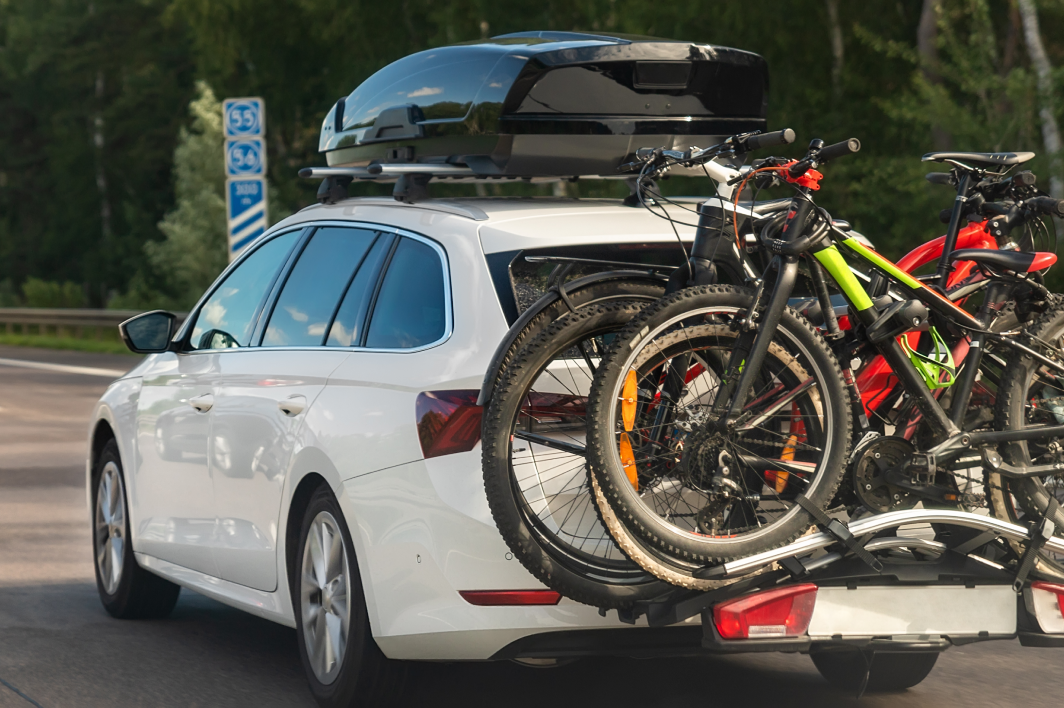
These attach to the car's trailer hitch. They are sturdy platforms onto which the bicycles are loaded.
- Pros: This is the most convenient and secure system for mounting and removing bikes. Barely affects the vehicle's aerodynamics, so the impact on fuel consumption is minimal. Many models are foldable to allow access to the trunk.
- Cons: Requires the prior installation of an approved trailer hitch, which involves a high initial cost. Because they block the lights and license plate, it is mandatory to install an additional license plate holder with its own lights and the V-20 sign.
Trunk-mounted bike racks
These attach to the trunk hatch using a system of straps and supports.
- Pros: They are more affordable than hitch-mounted racks and require no prior installation. They are a good option for occasional use.
- Cons: Installation can be more complex, and if not done correctly, it can damage the car's paint. Like hitch-mounted racks, they usually block the lights and license plate, so they also need a license plate holder and the V-20 sign. They are not compatible with all car models.
Transporting inside the vehicle
If you have a spacious vehicle, such as a minivan or a van, you can opt to carry the bicycle inside.
- Pros: This is the safest option against theft and the most economical, as it requires no accessories. It does not affect fuel consumption at all.
- Cons: Drastically reduces space for passengers and luggage. It is easy to dirty or damage the car's interior. The bicycle must be properly secured so it does not become a projectile in the event of sudden braking or an accident.

Is it mandatory to use a sign for bike racks?
Yes, as we mentioned earlier, it is mandatory. Whenever the load you are transporting (in this case, the bicycles) extends beyond the rear of the vehicle, you must properly signal it to warn other drivers. Failing to do so is not only a risk to road safety but also carries a financial penalty.
What is the bike rack sign and how is it used?
Going into more detail, the mandatory signaling for bike racks is known as the V-20 plate. This is a square panel (50x50 cm) with alternating diagonal red and white stripes. Its use is regulated by the General Vehicle Regulations and is essential for safe driving.
The way to place it depends on how far the load extends:
- If the bicycle does not exceed the width of the vehicle (including the side mirrors): You must place a single V-20 plate at the rear extremity of the load, centered.
- If the bicycle exceeds the width of the vehicle: You must place two V-20 plates at the extremities of the load, so that the stripes form an inverted "V".
Common mistakes when transporting bikes in your car
Avoiding the most frequent mistakes is key to ensuring an incident-free trip. Pay attention to these points to avoid making them.
Not securing them properly
A very dangerous mistake is not fastening the bicycles securely to the rack or not attaching the rack properly to the car. Vibrations and wind can cause the fastenings to loosen. Always check all straps, tie-downs, and anchors before leaving and after the first few kilometers.
Overloading the vehicle
Every vehicle and every bike rack has a maximum weight limit that must not be exceeded. Consult the manual for both to know the maximum permitted load. Excess weight affects the vehicle's stability, braking system, and fuel consumption.
Using an incompatible bike rack
Not all bike racks work for all cars. Make sure the system you choose is compatible with your vehicle model. A trunk-mounted rack, for example, may not fit properly if your car has a rear spoiler.
Not complying with signaling regulations
As we have seen, not using the V-20 bike rack plate when it is mandatory is a serious infraction. The same applies if the bike rack or bikes block the lights or license plate and no additional support is installed.
Forgetting about the extra height or width
If you use a roof-mounted rack, always keep in mind your vehicle's new height to avoid problems in parking garages, toll booths, or tunnels. If you use a rear-mounted rack, remember that the car is longer, which affects parking maneuvers.
Tips for safely transporting bicycles in your car
To ensure your only concern is enjoying the bike route, follow these final recommendations.
Choose the right bike rack
Consider the frequency of use, the type of car you have, the number of bicycles you typically transport, and your budget. Investing in a good retention system is investing in safety.
Check the installation before every trip
Before setting off, take a few minutes to verify that everything is properly installed and secured. Pull on the bicycles and the rack to ensure there is no play.
Drive with caution
Your car's handling changes when you are carrying an extra load. Aerodynamics are affected, the center of gravity shifts, and braking distances increase. Drive more smoothly, reduce your speed, especially on curves, and increase your following distance.
Make stops to check the load
On long trips, it is advisable to stop periodically to check that everything is still in place and properly secured. Take advantage of these breaks to rest. You can plan your route and locate Moeve Service Stations to make a strategic stop.

Frequently asked questions about transporting bicycles in your car
If you have questions about how to transport your bike in your car, here we answer the most common ones so you can do it in a practical and safe manner.
How many bicycles can I carry in my car?
It depends on the type of bike rack and the manufacturer's specifications. Most systems allow for transporting between 2 and 4 bicycles. Never exceed the maximum number or weight indicated.
How do I carry two bikes in a car?
Most bike racks are designed to carry two or more. The trick is to position them so they don't rub against each other. You may need to turn the handlebars or remove the pedals so they fit better.
Transporting your bicycles in your car is the gateway to endless adventures. By doing it correctly and safely, you ensure that the only star of the day is the pleasure of pedaling.
Learn more
If you want to know more details about the regulations regarding the use of the V20 plate, visit this link to the BOE (Official State Gazette) with the General Traffic Regulations: https://www.boe.es/buscar/act.php?id=BOE-A-2003-23514